Self-organizing adventures in frequency domain
Aleksandr Groznykh • dem.eco
Exploring Spectral Losses, Fourier NCAs, and LTI Dynamics
Why the Spectral Domain in ALife?
Inherent Limitations of Spatial NCAs
- Localized Receptive Fields: Message passing is bounded, requiring many steps to coordinate distal regions.
- Boundary Artifacts: Standard grid representations struggle at borders without arbitrary padding rules.
- Resolution Dependence: Scales poorly when migrating trained weights to higher-resolution canvases.
The Fourier Advantage
- Global Communication: A single coefficient in FFT space influences the entire spatial image natively.
- Periodic Boundaries: Frequency domain representations naturally provide periodic (toroidal) boundary conditions.
- Closed-Form Tractability: Linear Time-Invariant (LTI) systems can be evaluated directly across multiple steps.
Fourier Loss for Structured Environments
Standard spatial MSE (L2) loss often leads to incoherent, localized structures.
Fourier loss matches spectral profiles, yielding coherent modal patterns resembling physical Chladni resonance.
Running the NCA inside the FFT
Spectral State Space
- Instead of updating pixel states, we execute cellular updates directly in the Fourier spectrum.
- For real-valued spatial output, we only need to update half of the spectrum (exploiting conjugate symmetry).
- Convolutions inside spatial models are replaced with element-wise multiplications, transforming local dynamics into spectral coordinate modifications.
The Convolution Theorem & LTI NCA
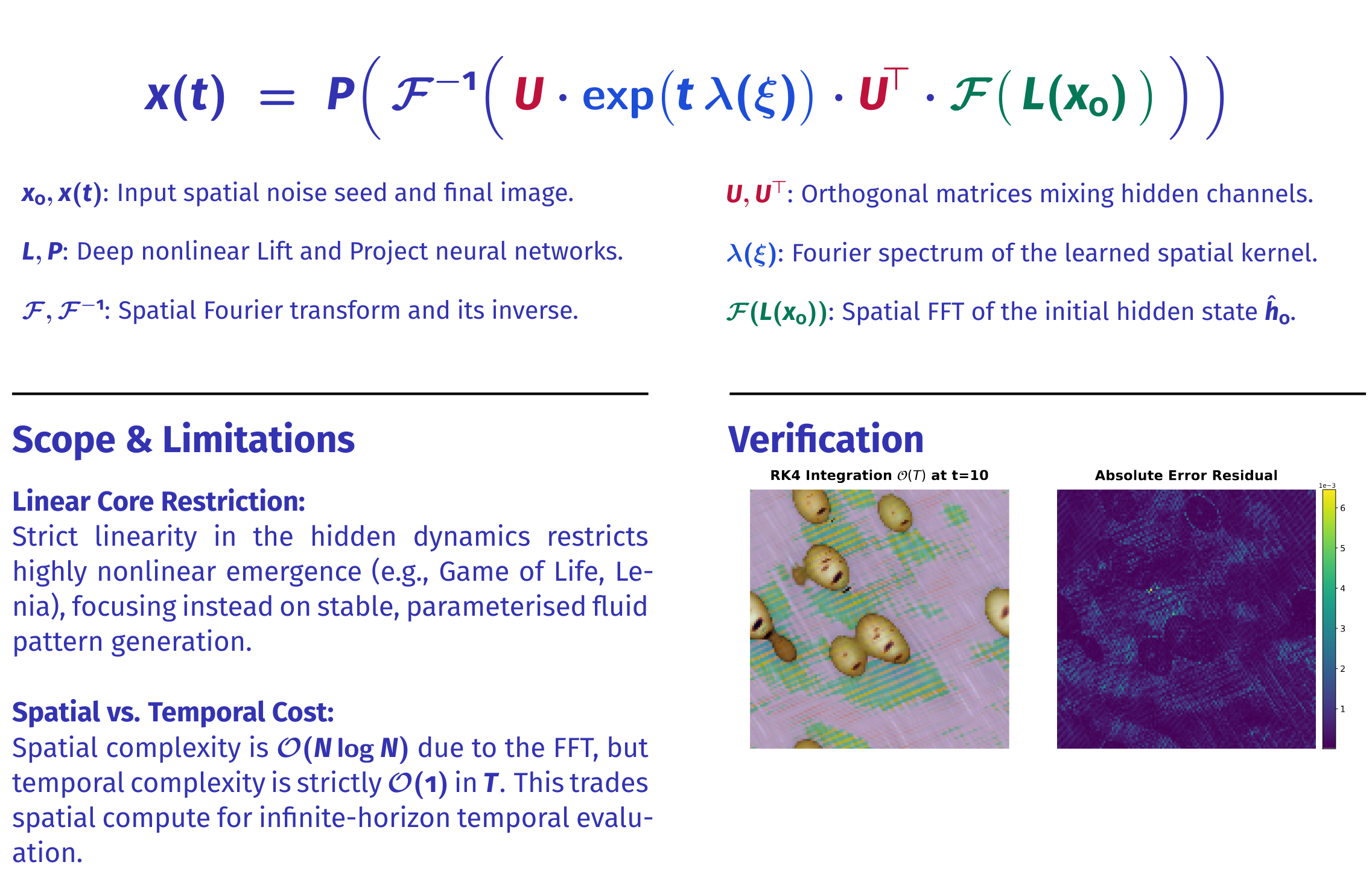
Note: Spatial deep learning "convolutions" are often cross-correlations. In the Fourier domain, circular convolution is point-wise multiplication.
Closed-Form Visualizations
Evaluating linear transformations in closed form generates stable textures, complex visual structures, and predictable physical behaviors.
Properties & Extended Horizons
Can Closed-Form Systems Regenerate?
- Because they are linear systems, they lack the non-linear attractors typical of traditional NCAs.
- However, they can be trained to map standing waves to target outputs.
- When damaged, the underlying wave properties naturally regenerate the missing visual structures over time.
Non-Euclidean Horizons
- Alternative Topologies: We can map coordinates onto manifolds like the Klein bottle using spectral coordinate adjustments.
- Fractional FFT (FRFT): Offers a continuous transition between pure spatial and pure spectral domains, opening up intermediate coordinate spaces.
Summary & Resources
Integrating spectral methods into artificial life systems offers several useful capabilities:
- Global context is handled naturally, avoiding the need for deep convolutional hierarchies.
- Circular boundary conditions come for free, removing edge artifacts.
- Closed-form equations allow us to study complex, long-term spatial trajectories analytically.
Sources & Notebooks
-
Spectral NCA:
github.com/algroznykh/spectral_selforg/spectral_nca.ipynb -
Closed-Form NCA :
github.com/algroznykh/closed_form_nca